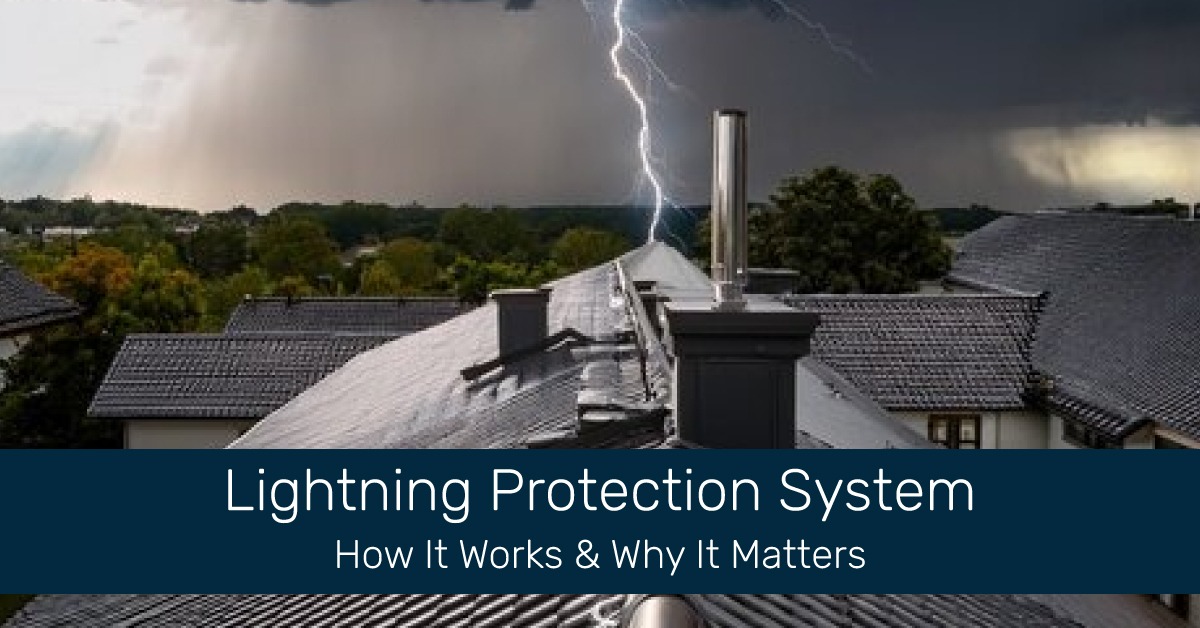
Lightning Protection System: How It Works & Why It Matters
Lightning is one of nature’s most powerful elements; it is unpredictable, fast, and devastatingly powerful. Every year many businesses and residences, as well as commercial buildings and critical infrastructure, are severely impacted by lightning strikes. Fortunately, a Lightning Protection System will greatly reduce these types of risks.
These modern systems (offered by iTorrent Industries and others) are specifically engineered to protect individuals, facilities (both residential/commercial), pieces of equipment and electrical networks from lightning damage. Learning how these systems function and why you should consider them when planning your next safety strategy is vital to ensuring you're protected.
What Is A Lightning Protection System?
A Lightning Protection System (LPS), as the name implies, is an arrangement of various components that will intercept the energy released from lightning, carry it safely down into the earth, and thus protect your facility from a lightning strike. Instead of allowing a lightning strike to occur directly to a facility resulting in fire, short circuit, outage, structural damage, etc., the LPS provides a safe route for energy discharged from a lightning strike to be carried safely away from your facility.
Typical systems that are provided to protect structures from lightning are:
Air Terminals (Lightning Rods)
Down Conductors
Grounding System
Surge Protection Devices
Bonding & Interconnecting Materials
Each component serves a specific purpose and, in combination, provides a means of directing the lightning safely away from your building.
What is the Operation of Lightning Protection Systems?
Though lightning seems random, it actually behaves according to electrical principles. The Lightning Protection System (LPS) protects your assets by using those same electrical principles in a three-step process.
1. The lightning strike is intercepted
The roof, tower, or exposed point of the structure with an air terminal (lightning rod) has specific locations where the terminal should be placed to intercept any lightning that might strike your facility prior to striking a more critical part of your facility.
2. The current is carried safely to Ground
Once a lightning strike has been intercepted, the current travels along the down conductors to the grounding pathway. The down conductor is designed to be a low-resistance pathway, allowing the extremely high amount of electrical energy generated during the lightning insertion to reach the ground efficiently.
3. Grounding
Dispersing energy into earth or ground is the final step of a working lightning protection system; proper grounding will allow for the lightning energy to dissipate so that the energy is not a hazard to anyone or anything. Proper grounding of the building will prevent any of the building to be electrically charged after a lightning strike.
To be fully protected, surge protection device (SPD) should be installed on all electrical and electronic systems against lightning-induced voltage surges as well as voltages created during switching operations.
The Importance of a Lightning Protection System:
1. To Protect Life and Property
Lightning has caused many fires, explosions and electrocutions. The installation of a Lightning Protection System (LPS) will reduce the possibility of harm to personnel in any facility.
2. Avoid costly downtime
Industries that store sensitive equipment, such as data centres, hospitals, factories, and telecom towers, are at a huge risk for huge financial losses because of power outages or damage to their equipment. An LPS can help prevent these interruptions.
3. Compliance requirements
Many regions or industries require Lightning Protection Systems (LPS) to meet building codes, safety certifications, and insurance compliance.
4. Protects against electrical/electronic damage
Lightning can generate high-voltage surges that can instantly destroy control panels, machinery, computers, or communications networks. Overall, with the installation of surge protection devices, electrical/electronic equipment will remain operational and have a longer life span.
5. An LPS reduces maintenance and costs
An LPS is installed once and requires very little maintenance while having many decades of life, making it very cost-effective.
When Should You Install a Lightning Protection System (LPS)?
There are several scenarios that may indicate that an LPS should be installed.
An LPS should be installed if your facility is located in:
A building taller than other structures nearby
If your facility contains costly sensitive equipment (for example, an Industrial or Commercial) facility.
If your facility is a Public Building, School, Hospital, or Warehouse.
If your facility is a storage facility for Flammable or Explosive materials
All of these locations should have LPS installed.
Existing residential structures will benefit significantly by having LPS installed as well.
Summary
The installation of a Lightning Protection System should not only be viewed as a Safety System. It should also be seen as an additional line of defence for your building, contents and people. Due to the increase in global lightning activity, investing in a well-thought-out, professionally engineered lightning protection system is one of the best investments you can make.
For International standards, advanced lightning protection designs, please visit iTorrent Industries' website here:
👉 Lightning Protection Systems - iTorrent Industries