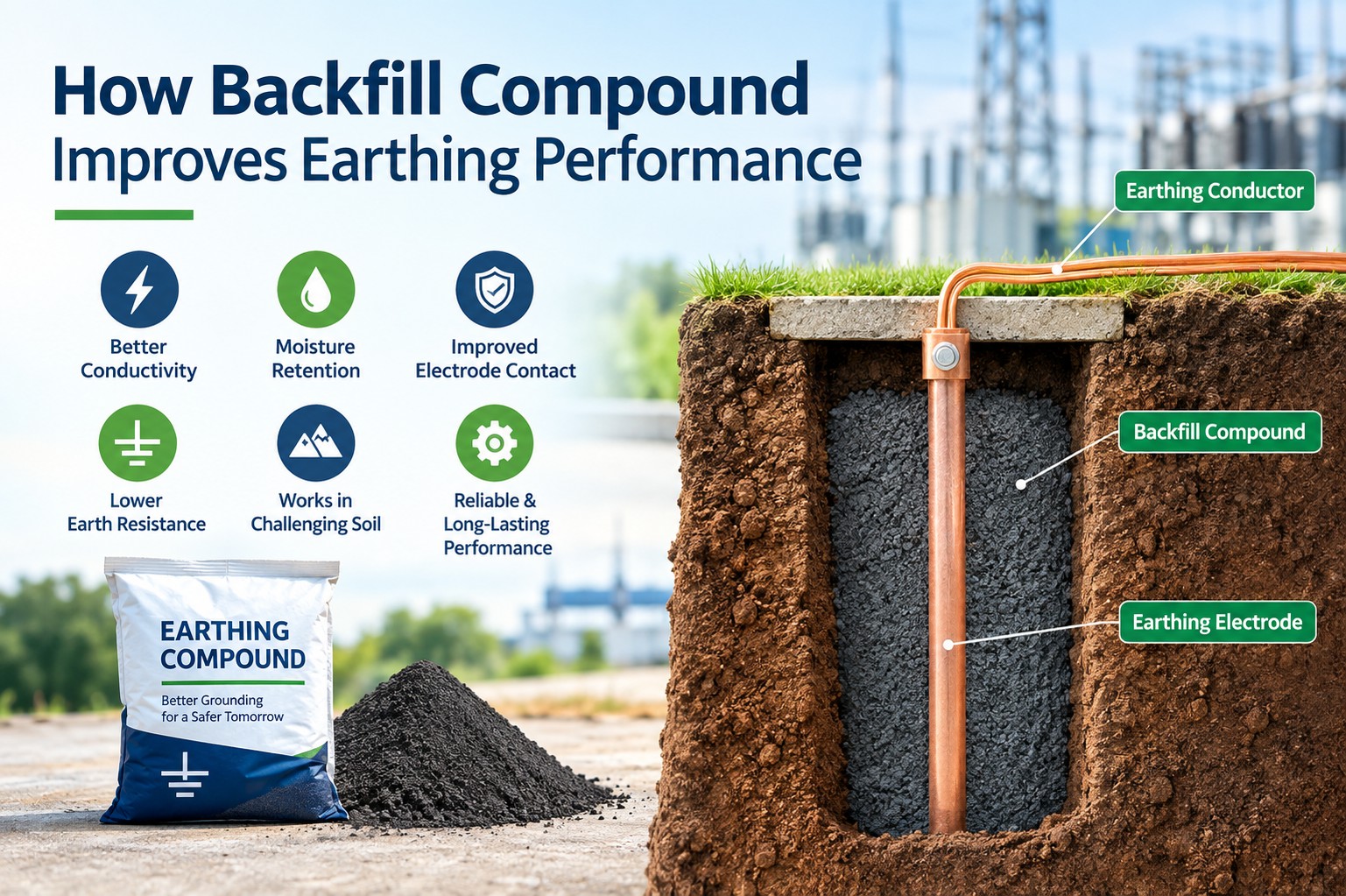
How Backfill Compound Improves Earthing Performance
A good earthing system needs a safe, reliable path for fault current to travel through. The trouble is, dry soil, poor contact between the electrode and the ground, and high soil resistivity can all get in the way of that. This is exactly the kind of problem an earthing compound is designed to solve.
Essentially, a suitable backfill material is packed around the earthing electrode to improve the conductive environment it sits in. Depending on how it's formulated, it can also help the soil hold onto moisture and give the electrode much better contact with the ground around it.
What Is an Earthing Compound?
An earthing compound is a conductive, earth-enhancing material that goes around an earthing electrode to improve how well it makes contact with the surrounding soil.
It fills in the gaps around the electrode and creates a more even, conductive zone. You'll hear it called a few different things depending on who you're talking to — backfill earthing compound, ground enhancement material, or earth resistance enhancement compound are all common names for more or less the same thing.
Which product is right for a given job really comes down to the soil conditions, the type of electrode being used, how the system is designed, and the grounding performance you're aiming for.
How Does Backfill Compound Improve Earthing Performance?
An earthing system's performance hinges on a handful of factors: soil resistivity, how the electrode is designed, moisture levels, and how well the whole thing was installed. Backfill material works by improving the conditions right around the electrode itself.
Improves Electrode-to-Soil Contact
Loose soil and air pockets can interrupt the path current needs to travel between the electrode and the ground. Backfill material fills in those gaps, giving you steadier, more consistent contact all the way around the electrode.
Creates a More Conductive Zone
A well-formulated compound acts as a conductive medium surrounding the electrode. That's especially valuable in soil with high resistivity, where natural grounding conditions aren't doing you any favours to begin with.
Helps Retain Moisture
Dry soil tends to carry higher electrical resistance. Some compounds are built specifically to hold moisture near the electrode, which helps keep the surrounding area conductive without needing constant watering.
iTorrent's Backfill Earthing Compound is a good example — it's moisture-retaining and built to maintain conductivity without needing continuous water present.
Supports Consistent Grounding
Soil conditions shift with the seasons and the weather. A good backfill material helps keep things more stable around the electrode over time, though it's worth remembering that overall performance still comes down to the earthing design as a whole.
Key Earthing Compound Benefits
At a glance, here's what a quality earthing compound can offer:
-
Better electrode-to-soil contact
-
More favourable conductive conditions around the electrode
-
Moisture retention, in the right formulations
-
Support for grounding in high-resistivity soil
-
More consistent performance as soil conditions change
-
Suitability across a range of industrial and commercial applications
That said, actual performance always comes back to the formulation, the soil itself, and how well the installation was done.
Types of Backfill and Earth Enhancing Compounds
Not all products are built the same way — the materials and formulations vary quite a bit.
Bentonite-Based Materials
Bentonite is good at absorbing and holding onto moisture, which makes it a solid choice anywhere moisture management around the electrode is a priority.
Graphite or Carbon-Based Compounds
Graphite and carbon-based materials get used mainly for their conductivity. iTorrent's product, for instance, is graphite-based and carries a stated resistivity below 0.2 ohm-metre.
Other Conductive Formulations
Some products blend conductive minerals with moisture-retaining materials. How well these perform can vary quite a lot, so it's worth checking the technical specs before making a choice. These are often lumped together under the broader label of earth enhancing compound.
Where Is Earthing Compound Used?
You'll find earthing compound doing its job across a wide range of settings, including:
-
Industrial plants
-
Manufacturing facilities
-
Electrical substations
-
Solar power installations
-
Telecom infrastructure
-
Data centres
-
Commercial buildings
-
Transformers and generators
-
Electrical panels
-
Lightning protection systems
It tends to be most useful in places where the natural soil conditions make it genuinely hard to get decent grounding performance without a bit of help.
Earthing Compound for Chemical Earthing: Why Is It Used?
In chemical earthing, the electrode and the surrounding backfill material work together with the soil as a system. The compound helps build a suitable conductive environment around the electrode and, depending on the formulation, can assist with moisture retention too.
If you're choosing an earthing compound for chemical earthing, make sure to check its compatibility with the electrode, review the technical specs, and follow the recommended installation method.
It's worth keeping in mind that the compound is just one piece of the overall earthing system — it's not a substitute for proper electrode design and testing.
What Makes the Best Earthing Compound?
There's no single product that's the right fit for every project. Before you buy, it's worth weighing up:
-
Electrical resistivity — check the manufacturer's tested figures.
-
Material composition — is it graphite-, bentonite-, carbon-, or mineral-based?
-
Moisture retention — this matters more in dry or unpredictable soil conditions.
-
Electrode compatibility — the compound needs to suit the electrode you're using.
-
Testing — look for reliable, documented test reports.
-
Application — match the product to your soil conditions and project needs.
This kind of approach will serve you far better in the long run than simply going with whatever's cheapest.
How to Choose an Earthing Compound Supplier
When you're picking an earthing compound supplier, don't just look at the price tag. Check whether they can offer:
-
Clear technical specifications
-
Product testing documents
-
Consistent material quality
-
Suitable packaging
-
Bulk supply
-
Delivery support
-
Technical assistance
For industrial-scale projects especially, these details can make procurement and installation a lot smoother.
Why Work With an Earthing Compound Manufacturer?
Partnering with an experienced earthing compound manufacturer usually means better access to product specs, testing data, and technical support when you need it.
iTorrent Industries Pvt Ltd manufactures and supplies a full range of earthing products, including Backfill Earthing Compound, earthing electrodes, strips, plates, and other grounding materials.
Their Backfill Earthing Compound is graphite-based, moisture-retaining, non-toxic, and carries a stated resistivity below 0.2 ohm-metre.
How to Install Backfill Compound Around an Earthing Electrode
The exact steps will depend on your project design and the manufacturer's instructions, but a typical installation looks something like this:
-
Prepare the earthing pit.
-
Install the chosen electrode.
-
Place the recommended compound around the electrode.
-
Make sure there's proper contact all around the electrode.
-
Complete the earthing conductor connection.
-
Close and protect the pit as specified.
-
Test the completed earthing system.
How much compound you'll actually need depends on the electrode size, pit dimensions, soil conditions, and the specific product's requirements.
Earthing Compound vs Salt and Charcoal
|
Factor |
Earthing Compound |
Salt & Charcoal |
|
Purpose |
Grounding enhancement |
Traditional soil treatment |
|
Conductivity |
Designed for earthing applications |
Can vary with conditions |
|
Moisture behaviour |
Product dependent |
Strongly affected by soil moisture |
|
Corrosion |
Depends on formulation |
Salt can increase corrosion risk |
|
Performance |
Depends on product and installation |
Can vary over time |
More and more, modern grounding projects lean toward purpose-designed enhancement materials, mainly because their properties can actually be checked and verified through technical specifications — something you can't really say for salt and charcoal.
How to Maintain Earthing Performance After Installation
Installing the system is really just the first step. Regular checks are what help you catch changes in performance before they become a problem.
Good practice includes:
-
Periodic earth-resistance testing
-
Inspecting accessible connections
-
Checking the overall condition of the system
-
Keeping test records
-
Following the manufacturer's recommendations
Testing matters because, on its own, the compound can't guarantee any particular earth-resistance value — it's one part of a bigger picture.
Why Choose iTorrent Industries for Earthing Solutions?
iTorrent Industries offers a full lineup of earthing products for industrial, commercial, and infrastructure projects — including Backfill Earthing Compound, electrodes, strips, plates, and other grounding materials.
If you're planning an earthing installation, it's worth talking through your soil conditions, electrode type, quantity, and overall project requirements with your supplier before settling on a final product.
Need a suitable earthing compound for your project? Get in touch with iTorrent Industries to discuss your technical and bulk-supply requirements.
FAQs
1. What is an earthing compound?
An earthing compound is a conductive, earth-enhancing material placed around an earthing electrode to improve the electrical environment between the electrode and the surrounding soil.
2. How does backfill earthing compound reduce earth resistance?
It improves electrode-to-soil contact and creates a more conductive zone around the electrode. The actual result depends on soil conditions, electrode design, and how well the system was installed.
3. What are the main earthing compound benefits?
Better electrode contact, improved conductive conditions, and moisture retention in the right formulations are the big ones.
4. Where is earthing compound used?
Industrial plants, substations, solar projects, telecom installations, commercial buildings, transformers, generators, and plenty of other electrical installations.
5. Can earthing compound be used for chemical earthing?
Yes — suitable backfill materials work well with chemical earthing systems, helping create the right conductive environment around the electrode.
6. How do I choose the best earthing compound?
Look at electrical resistivity, material composition, moisture retention, electrode compatibility, testing documentation, and how well it suits your soil conditions.
7. How much earthing compound is required?
It depends on the electrode, pit dimensions, soil conditions, and the manufacturer's recommended application method.
8. How can I choose a reliable earthing compound supplier?
Look for clear technical specifications, quality testing, consistent products, bulk-supply capability, and solid technical support.