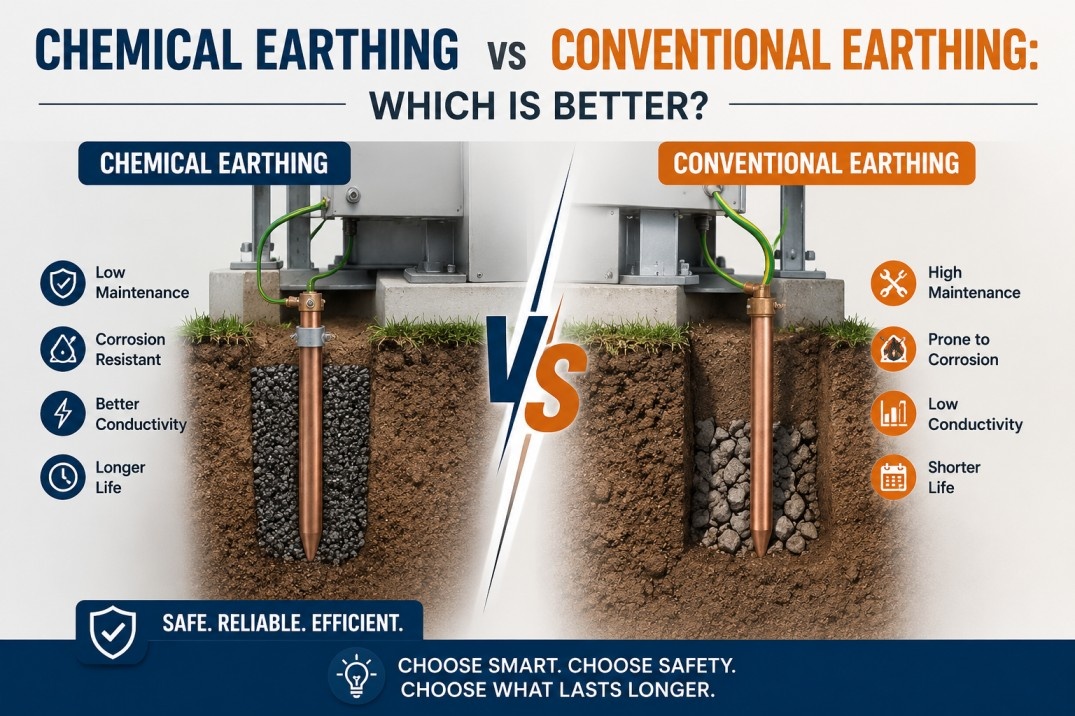
Chemical Earthing vs Conventional Earthing: Which Is Better?
A reliable earthing system is vital for guaranteeing the safety of the user and the equipment. When comparing chemical earthing and traditional earthing, some of the significant factors are the ease of maintenance, long-term performance, and longevity. Traditional earthing, as the name implies, relies on some traditional materials such as salt and charcoal. On the other hand, chemical earthing has advanced ground solutions that can keep ground resistance low, even if the soil changes. Due to the efficiency and reliability, chemical earthing systems are the preferred option in today’s electrical installations. Backfill compounds improve earthing systems by altering the resistivity and the conductivity of soil. At iTorrent Industries PVT LTD, we provide earthing systems that create safe electrical grounds and industrial systems along with reliable earthing over time.
Understanding Earthing Systems and the Role of Backfill Earthing Compound
A properly designed earthing system safely grounds fault current and protects both people and equipment from the dangers of electricity. In industrial, commercial, and domestic systems that contain continuous operating electrical systems, earthing that is reliable is of paramount importance. Backfill Earthing Compound is one of the major advancements that modern earthing systems have incorporated to help reduce soil resistivity and enhance the conductivity of the system. This compound helps the earthing electrode improve the contact with the surrounding soil and other materials. In many instances, the effectiveness of a grounding system is further complicated by dry and rocky soils. Backfill compounds also help earthing electrodes retain moisture, thus enhancing their longevity.
What Is Chemical Earthing?
Chemical earthing, as a method, is superior in that it combines electronic with chemical processes to provide even more efficient, stable, and reliable earthing year-round. It was created to provide an answer to grounding needs where soil conditions are poor, especially where dry soils can't provide the necessary moisture. It was also purposely designed to require little to no supervision or maintenance once installed, making it perfect for use in Industrial and Commercial plants and telecommunications. Safety also plays a huge role in the choice for Chemical earthing; it is highly effective for electrical grounding and safeguarding equipment in order to keep it safe from current or electrical fluctuations.
What Is Conventional Earthing?
Conventional earthing relies on one method for grounding needs, and that is using copper or galvanized iron with the addition of charcoal and salt. This method has been used for years, for small residential grounding needs. This method is useful in the beginning, but its effectiveness fades if the soil changes or if the soil loses moisture. To ensure effective grounding, regular maintenance is required. This is further complicated if the soil has high resistivity. For the most part, the costs of conventional earthing outweigh the benefits, especially in comparison with other grounding methods that are more modern and reliable and require little to no maintenance.
Chemical Earthing vs Conventional Earthing – Key Differences
Durability, maintenance, and performance are all important aspects for chemical earthing compared to conventional earthing. Chemical earthing systems are said to be easier to install and maintain. The performance of conventional earthing is more variable and often requires periodic watering and replacement of materials. Even in dry/high-resistivity soils, chemical earthing maintains low ground resistance where conventional earthing does not. Chemical earthing can also be less costly as a long-term investment due to its maintenance and reliability when compared to conventional earthing, despite its high initial cost.
How Backfill Earthing Compound Improves Earthing Performance
Backfill Earthing Compound directly impacts the performance of a grounding system. By lowering the resistivity of the soil and enhancing the earthing electrode's electrical conductivity and moisture content, stable ground resistance is achieved no matter the weather. Since it also protects the electrodes from corrosion, it extends their lifespan and lowers the system’s maintenance. The enhancement of grounding and conductivity provided by Backfill Earthing Compound also improves the dissipation of fault current. Thus, any industry looking for reliable earthing must use a quality earthing enhancement material.
Advantages of Chemical Earthing Over Conventional Earthing
Chemical earthing offers several advantages that make it the preferred choice for modern electrical installations. It provides lower and more stable ground resistance, better performance in dry soil, and minimal maintenance requirements. The system is highly durable and resistant to environmental changes, making it suitable for industrial facilities, commercial buildings, and renewable energy projects. Chemical earthing also improves equipment protection by ensuring effective fault current dissipation. These benefits contribute to enhanced electrical grounding safety and long-term operational reliability. As industries increasingly focus on performance and efficiency, chemical earthing continues to gain popularity as a superior grounding solution.
Conclusion
The decision for chemical earthing systems vs traditional earthing systems depends on the requirements of the project and the soil, as well as the expectations for performance in the future. For some standard applications, traditional earthing systems may be enough. Backfill helps to increase earthing system efficiency and also further enhances the earthing system by improving the conductivity and reducing the resistivity of soil. iTorrent Industries PVT LTD offers advanced earthing systems. They help protect the infrastructure through improved electrical safety and ensure reliable grounding for industrial and commercial systems. The correct earthing system is an investment for long-term safety and improved performance and efficiency.
FAQs
What is Backfill Earthing Compound?
It is a conductive material used to improve earthing performance and reduce ground resistance.
Which is better, chemical earthing or conventional earthing?
Chemical earthing offers better conductivity, durability, and lower maintenance.
Does backfill earthing compound improve earthing efficiency?
Yes, it helps maintain low resistance and improves grounding performance.
Is chemical earthing suitable for industrial applications?
Yes, it is widely used in industries for reliable and long-lasting grounding.
How long does chemical earthing last?
Chemical earthing systems have a longer lifespan with minimal maintenance.